When your excavator crawls slowly but powerfully across a jobsite, the component translating hydraulic power into ground force is the travel reduction gearbox — better known in the field as the final drive. It is the single most expensive component in the machine's travel system, and the one that must never fail. When it does, the machine doesn't just "move slowly" — it stops moving entirely.
Hydraulic motors are inherently "high-speed, low-torque" — they spin fast but can't push dozens of tons. The travel gearbox's job is to use a multi-stage planetary gear system to translate that high-speed rotation into low-speed, massive output torque:
Hydraulic pump → travel motor → drive shaft → planetary gear system → sprocket → track chain → machine movement
Reduction ratios are typically very high (tens-to-one depending on model). That's exactly why an excavator travels so slowly yet can climb steep grades and move its own weight of dozens of tons.
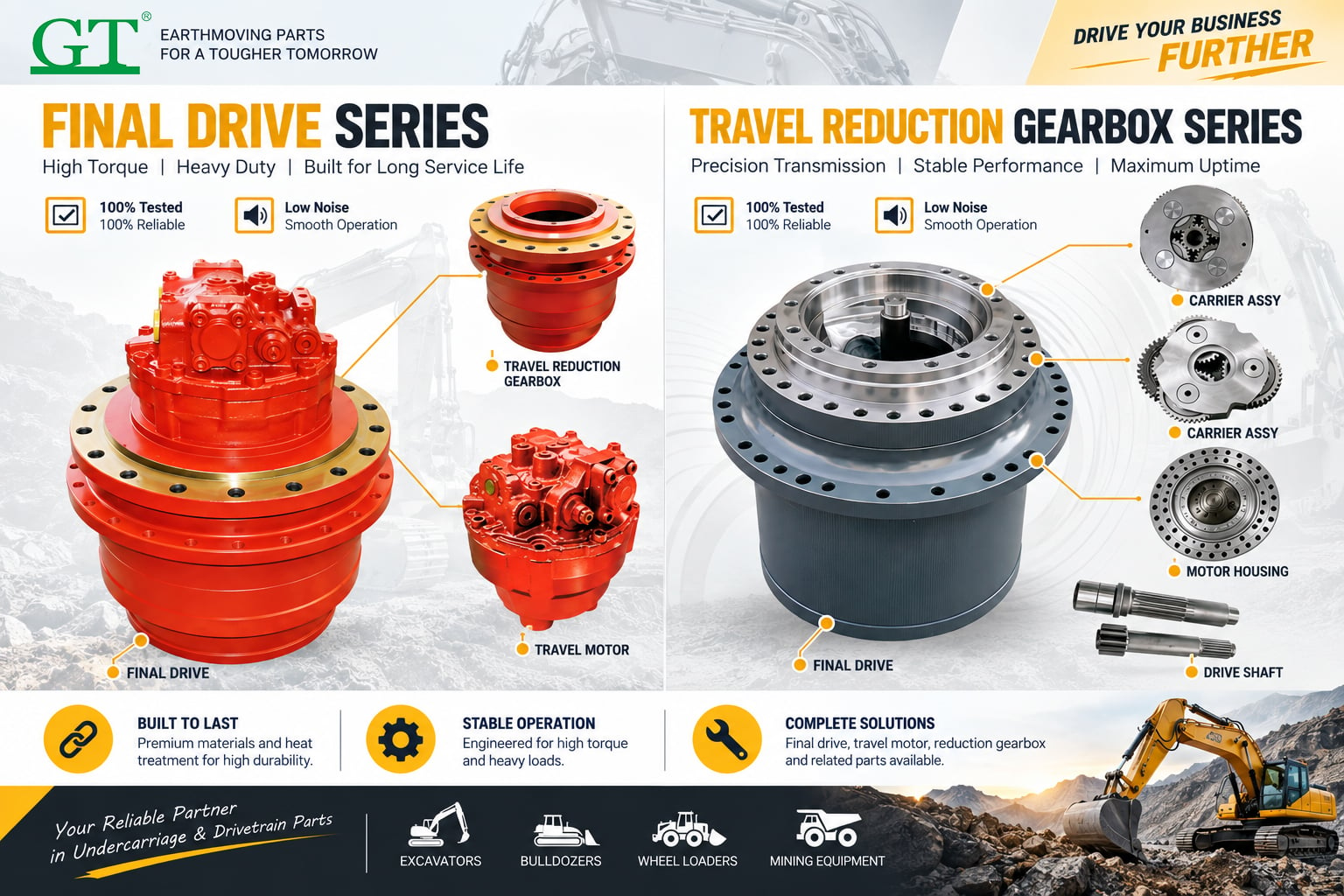
The main assembly, built on a high-strength housing that integrates the planetary gear set, brake, and bearing system. It plays a dual role: power transmission and load bearing — not only driving the track, but absorbing all reaction forces and impacts coming back from the chain.
The core load-bearing member of the planetary system, holding the planet gears and transmitting torque. Multiple planet gears are arranged symmetrically on the carrier so that load is distributed evenly — the key to achieving high reduction ratios, high torque output, and smooth rotation. Carrier machining precision directly determines the machine's noise level and service life.
The mounting and protective housing for the hydraulic motor, which also connects and locates the motor to the gearbox body. Its concentricity determines the alignment precision between the drive shaft and the planetary system — any eccentricity causes abnormal wear and noise.
A precision-machined splined shaft that transmits the hydraulic motor's output torque into the planetary gear system. Spline tooth accuracy, heat treatment hardness, and surface finish directly affect transmission efficiency, noise, and fatigue life.
Product Features: Every unit in this travel reduction gearbox series undergoes 100% testing before shipment, with optimized gear meshing accuracy and bearing matching — delivering low-noise operation and consistent torque output.
This is the lethal logic most owners overlook — a two-way damage loop between the final drive and undercarriage components:
| Direction | Mechanism | Consequence |
|---|---|---|
| Undercarriage wear → damages final drive | As chain pitch stretches and sprockets wear, meshing becomes intermittent, generating cyclical impact loads | Impacts travel straight into the gearbox bearings and gears, accelerating pitting and spalling |
| Final drive failure → accelerates undercarriage scrapping | Weak or binding travel on one side makes the machine drift, overloading one track | Chain, rollers, and sprocket wear rapidly on that side |
Conclusion: Replace a final drive without inspecting the undercarriage, and the new unit can be beaten up by the old undercarriage's impact loads within a few hundred hours. Conversely, continuing to run a heavily worn undercarriage means paying for an expensive final drive on behalf of a worn-out chain.
| Symptom | Likely Cause |
|---|---|
| Weak travel on one side, machine drifts | Motor internal leakage, damaged internal gears |
| Cyclical abnormal noise during travel | Planet gear pitting/breakage, bearing race spalling |
| Binding or intermittent stoppage | Seized internal bearing, brake not fully released |
| Machine rolls on slopes | Failed travel brake |
| Oil weeping from gearbox base | Aged output shaft seal, clogged breather |
| Metal debris in return filter or oil | Severe gear/bearing wear (stop immediately) |
| Noticeably louder travel noise | Degraded gear meshing accuracy, excessive bearing clearance |
When replacing a travel reduction gearbox, always verify:
As a heavy equipment parts supplier, GT (Xiamen Globe Truth) advises: the travel reduction gearbox is a high-precision assembly that must be matched strictly to machine specifications. We also strongly recommend evaluating the remaining life of your undercarriage components when replacing a final drive — solving both ends at once is the only real path to cost efficiency.
The travel reduction gearbox is the excavator's legs; the undercarriage is its shoes. Worn shoes injure the legs — and injured legs wear out the shoes faster. Understand this two-way damage loop, and your machine will go further, for less.


 EN
EN