Get a Free Quote

Our representative will contact you soon.
Email
WhatsApp / Mobile
Name
Company Name
Message
0/1000

Excavator vs. Track Loader Undercarriages: Two Different Design Philosophies

Time: 2026-09-08

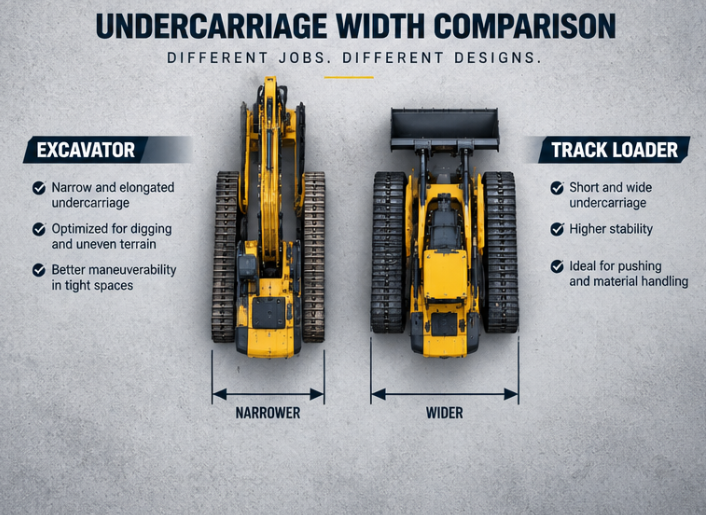
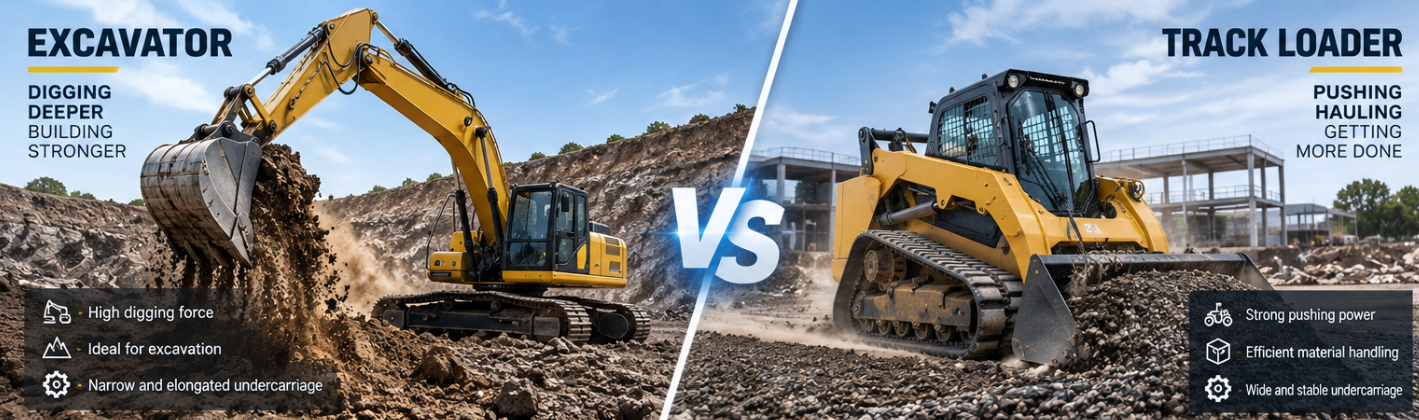
Both run on tracks — so why do excavators look "long and narrow" underneath while track loaders (including CTLs) look "short and wide"? It's not aesthetics. The two machines have fundamentally different working mechanics. Understanding this will immunize you against the "universal parts" marketing myth.
I. Working Mechanics: Where Everything Starts

I. Working Mechanics: Where Everything Starts

Dimension

Excavator

Track Loader

Core working mode

Swing in place + dig downward

Push forward + travel constantly

Primary force direction

Vertical downward(bucket reaction force)

Horizontal forward(bucket breakout force)

Travel frequency

Low (stationary for most cycles)

High (constant shuttling)

Center of gravity

Heavy upper structure; undercarriage is a "ballast base"

Low and central; undercarriage is a "propulsion platform"

II. The Resulting Design Differences

I. Working Mechanics: Where Everything Starts

1. Chassis Width & Track Gauge

  • Excavators: Relatively narrow track gauge, often with variable-gauge designs for transport on narrow sites. Stability comes from the counterweight and upper structure, not a wider base.
  • Track Loaders: Significantly wider chassis for greater lateral stability — the rollover risk during high-speed travel and digging is far higher than for an excavator.

2. Travel Speed & Drive System

  • Excavators: Low travel speed (typically 3-6 km/h); travel is a small share of duty time, so high-speed endurance is not a design priority.
  • Track Loaders: Travel speeds reach 10-12 km/h with constant forward/reverse shifting — placing far higher continuous-load demands on final drives, sprockets, and chains.

3. Roller Design

  • Excavators: Rollers carry static + impact loads; the priorities are impact resistance and seal durability.
  • Track Loaders (especially CTLs): Rollers run at high RPM for extended periods — the priorities are high-temperature lubrication and seal performance under high-speed rotation. CTL rollers must be specifically optimized for the high-friction environment of rubber tracks.

4. Track Shoe Design

  • Excavators: Mostly triple-grouser shoes balancing traction with in-place swing flexibility.
  • Track Loaders: Single-grouser or wider heavy-duty shoes for maximum drawbar pull during digging.

III. Warning: The Dangerous Myth of "Universal Parts"

The market is full of "universal" undercarriage parts claimed to fit multiple machine types. But as shown above, excavator and loader components face completely different load spectrums, speeds, and force directions:

  • Fitting an excavator roller to a high-speed loader → seal overheating, premature bearing failure.
  • Fitting a loader chain to an excavator → unnecessary weight and cost — plus potentially mismatched pitch.

GT's Position: Undercarriage parts must be machine-specific to OEM specifications — not "close enough." GT (Xiamen Globe Truth) strictly separates its product lines into excavator series and loader/CTL series, with every part matched to a specific machine's load spectrum and mounting dimensions.

IV. GT Dual Series at a Glance

Series

Compatible Machines

Design Focus

Excavator Series

CAT/Komatsu/Hitachi, 1.5-120t

Impact resistance, static load, long seal life

Loader/CTL Series

CAT/Komatsu/John Deere CTLs

High-speed operation, high-temp lubrication, lateral stability

Conclusion

Excavators and track loaders are machines with distinct "personalities" — and their undercarriages are equally specialized. When sourcing parts, always verify the machine model, series, and year. Matching the right series keeps every dollar working hard.


PREV : None

NEXT : Invitation to an In-Person Meeting in Eruope in Sep.

WhatsApp WhatsApp E-mail E-mail YouTube YouTube FaceBook FaceBook Linkedin Linkedin
email goToTop