 EN


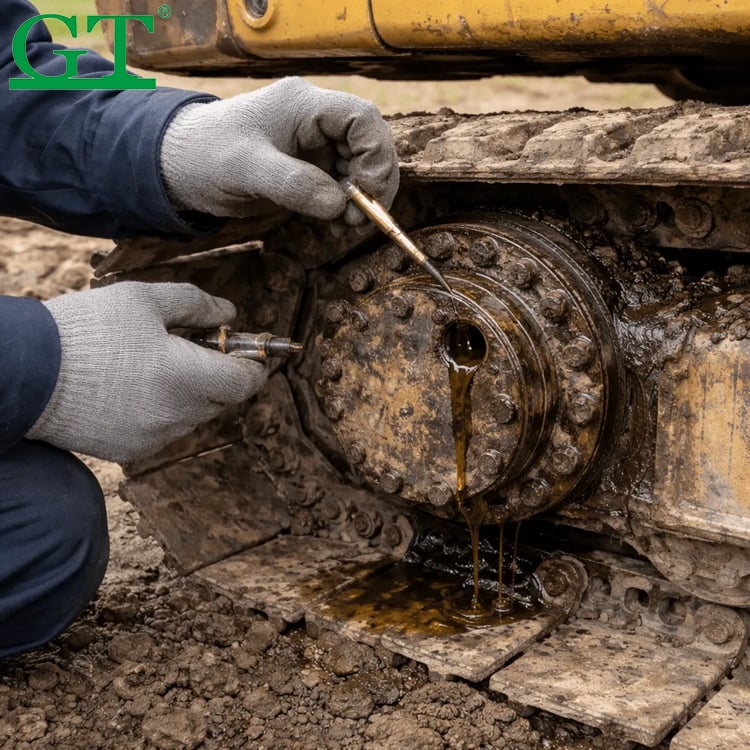
"The final drive is shot — replace it." This line is spoken in workshops every day, and a fair share of those calls are misdiagnoses.
The final drive is the most expensive assembly in the travel system — and the most frequently replaced by mistake. The real fault may be travel motor internal leakage, a stuck relief valve, a brake that isn't releasing, or simply an over-tight track. This article provides a complete Diagnose → Grade → Decide framework so every dollar of your repair budget goes to what's actually broken.
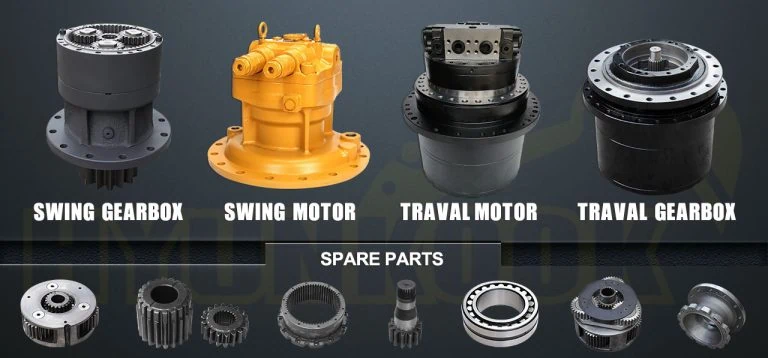
I. Step One: Confirm the Diagnosis Before You Disassemble
Before removing the final drive, complete these five checks. They cost almost nothing and eliminate a large share of "phantom failures."
1. Symptom Attribution Table: Is it "won't move" or "moves wrong"?
| Symptom | Check First | Commonly Misdiagnosed As |
|---|---|---|
| No travel at all (both sides) | Travel pilot pressure, control valve, brake release pressure, hydraulic pump | Failed final drive |
| Weak travel on one side / drifting | Travel motor internal leakage, relief valve, final drive internals | Failed final drive |
| Cyclical abnormal noise while traveling | Planet gears, bearings, sprocket engagement | — |
| Rolls on slopes | Travel brake, brake piston seals | Failed final drive |
| Binding / intermittent stoppage | Seized bearing, brake not fully released | Failed final drive |
| Oil weeping at housing base | Output shaft seal, clogged breather | — |
Key point: If both sides lose travel simultaneously, the odds of both final drives failing at once are extremely low — check the pump, pilot pressure, and control valve first.
2. The Case Drain Test — The Single Most Important Action
This is the dividing line between "motor problem" and "gearbox problem," and the core message of this article.
Procedure:
- Disconnect the travel motor's case drain line and connect a flow meter (or use a measuring container with a timer).
- Measure leakage flow under the specified condition (typically relief or no-load full speed).
- Compare against the machine specification.
Interpretation:
| Leakage Flow | Conclusion |
|---|---|
| Within specification | Motor is healthy → fault lies in the gearbox's mechanical section |
| Significantly above specification | Motor internal wear / valve plate leakage → repair or replace the motor first; leave the gearbox alone |
This test may cost only a few dozen minutes of labor — and prevents a multi-thousand-dollar wrong replacement.
3. Three More Quick Checks
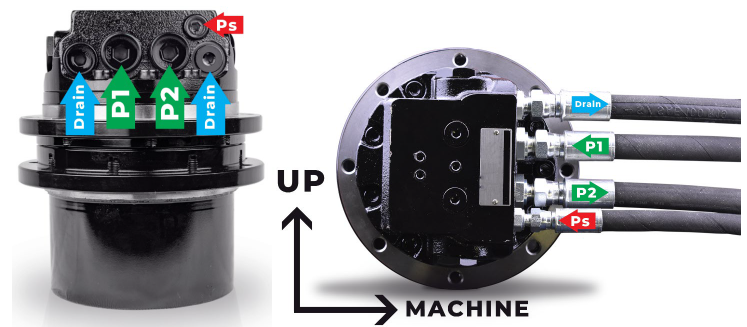
- Brake release pressure: Verify the brake port reaches release pressure (insufficient pressure causes "dragging brake" travel).
- Relief pressure: Measure both sides and compare for imbalance.
- Track tension and mud packing: An over-tight track or hardened mud creates a false "weak travel" symptom.
II. Step Two: Grade the Damage (Determines Whether Repair Is Viable)
Once mechanical failure is confirmed, grade it with the table below. The grade directly determines whether repair is still worthwhile.
| Level | Damage | Repair Viability | Typical Cost (% of New) |
|---|---|---|---|
| Level 1 | External leakage only (aged seals) | Fully repairable | 10% - 20% |
| Level 2 | Single bearing noise / one bearing worn | Repairable | 30% - 45% |
| Level 3 | Planet gear pitting / one stage damaged, housing intact | Depends on machine value (borderline) | 50% - 70% |
| Level 4 | Cracked housing, worn output shaft splines, multiple gear stages destroyed, metal debris throughout | Not recommended | Above 70% |
Rule of Thumb:
- Repair cost < 50% of new and damage limited to wear items → Repair
- Repair cost > 60% of new, or structural damage (housing, splines) → Replace
- In the 50%-60% borderline zone → use the full-cost formula below
III. Step Three: The Full-Cost Decision Formula
Looking only at parts price is the most common decision error. The real comparison is:
Repair total = parts + labor + downtime for two teardowns + risk cost of repeat failure Replace total = new unit price + labor + one downtime event − warranty value
The two most underestimated terms:
1. Repeat-failure risk cost Repair (especially Level 3) typically means "replacing the visibly broken parts," but hidden fatigue damage cannot be fully assessed. If it fails again within six months, you pay a second teardown plus a second downtime event — likely exceeding the cost of a new unit.
2. Downtime cost For mines and schedule-critical contractors, one day of downtime often exceeds the price gap between parts. In those cases, "slightly more expensive, available now, and warrantied" is genuinely the cheaper option.
Conclusion: When the machine has long remaining service life and high utilization, replacing with a new (warrantied) assembly is usually better on a risk-adjusted basis. When the machine is near retirement with low utilization, repair is the rational choice.
IV. Step Four: Decision Matrix by Machine Lifecycle
| Machine State | Damage Level | Recommended Decision |
|---|---|---|
| New / high utilization (2,000h+/yr) | Level 1-2 | Repair (preserves OEM consistency) |
| New / high utilization | Level 3-4 | Replace (avoid repeat failure delaying schedule) |
| Mid-life (5,000-10,000h) | Level 1-2 | Repair |
| Mid-life | Level 3 | Replace (repair risk now outweighs benefit) |
| Near retirement / low utilization | Level 1-3 | Repair (good enough is good enough) |
| Near retirement | Level 4 | Replace with used/reman, or consider disposing of the machine |
V. Step Five: Three Things You Must Do Either Way
This matters more than the decision itself — otherwise the new unit repeats the old one's fate:
- Check remaining undercarriage life: Stretched chain pitch and hooked sprocket teeth feed impact loads back into the new final drive. Old undercarriage + new final drive = rapid failure.
- Check hydraulic oil cleanliness: Test particle count and replace filters before installation. Contaminated oil is the #1 final drive killer — fix the oil, or even the best assembly merely delays failure.
- Start an oil analysis record: Sample on schedule after installation and track iron content trends. It's the cheapest early warning available.
VI. Supply Options Compared
| Option | Advantages | Risks | Best For |
|---|---|---|---|
| OEM new | Highest consistency, full warranty | Highest price, long lead time | New machines, in-warranty |
| Premium aftermarket new | Strong value, short lead time, typically warrantied | Requires a reliable supplier | Mainstream choice |
| Reman / rebuilt | Low price | Opaque internal condition, weak warranty | Near-retirement machines |
| Repair kit (seals/bearings) | Lowest cost | Only suitable for Level 1-2 | Light damage |
As a heavy equipment parts supplier, GT (Xiamen Globe Truth) recommends: run the case drain test first, grade the damage second, and apply the full-cost formula last — rather than replacing an assembly the moment you hear a noise. We also stress that a final drive's service ceiling is largely set by the health of your undercarriage and hydraulic oil.
Conclusion
The hard part of the final drive decision was never "repair or replace." It's "is it actually broken, how badly, and how long will the fix really last?" Answer those three, and your money won't be wasted.
Table of Contents
- I. Step One: Confirm the Diagnosis Before You Disassemble
- II. Step Two: Grade the Damage (Determines Whether Repair Is Viable)
- III. Step Three: The Full-Cost Decision Formula
- IV. Step Four: Decision Matrix by Machine Lifecycle
- V. Step Five: Three Things You Must Do Either Way
- VI. Supply Options Compared

